
Chapter 5
When the World Noticed
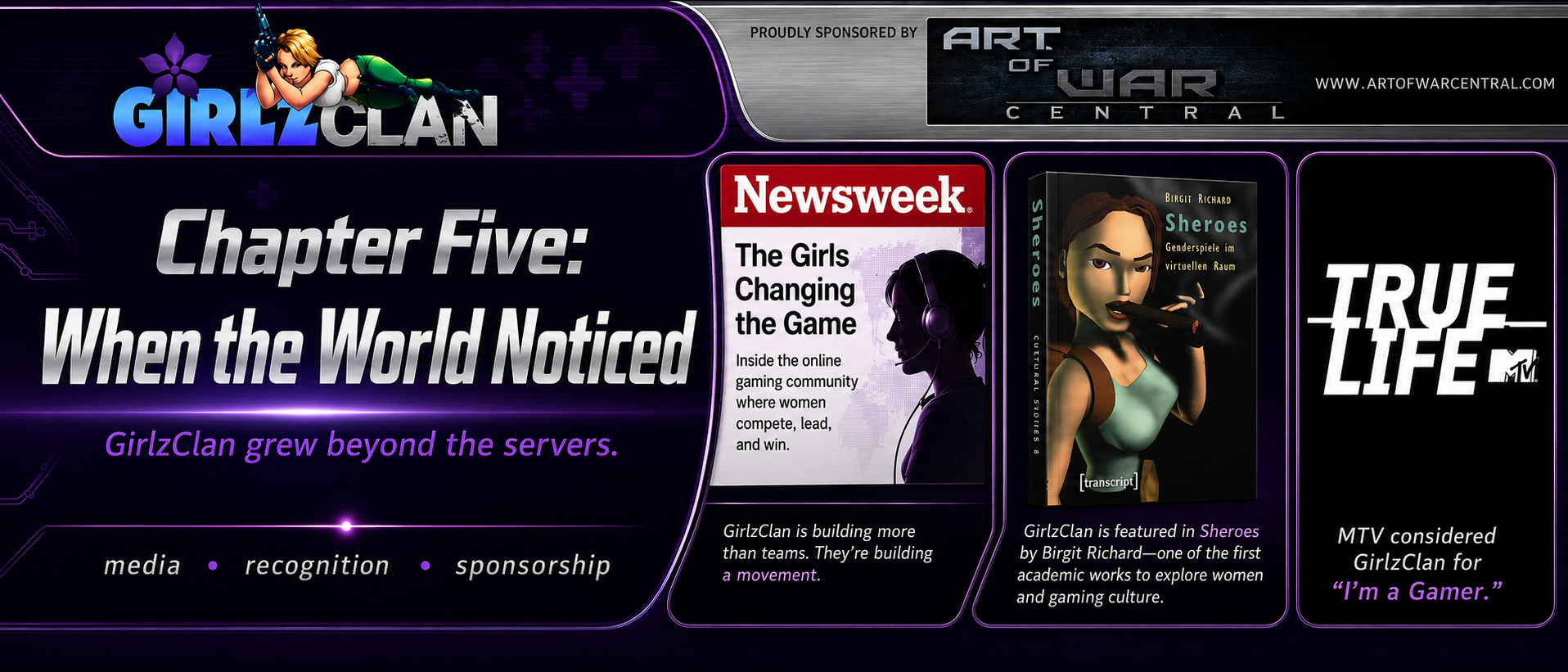
GirlzClan started attracting attention from gaming sites, sponsors, Newsweek, MTV, TechTV, and academic work, but its deepest impact stayed personal.
We’d spent years building GirlzClan because women needed it—not because we thought anyone outside our little corner of the internet was watching.
For a long time, the only recognition that mattered came from the women who kept returning.
They joined our servers, posted in the forums, wore the [*Girlz*] tag, and trusted us with pieces of their lives. Every new member was proof that the community mattered.
We didn’t need headlines to know that what we’d built was real.
Then the emails started arriving.
At first, they came from other women in gaming.
LadyGamers.com chose GirlzClan as its Focus of the Month and interviewed me about the clan, our former members, an upcoming tournament, the teams I respected, and what it was like balancing gaming with my life as a mother.
PC-Chick.com later interviewed LivingDeadGirl about belonging to an all-female gaming clan and competing in a space that was still overwhelmingly dominated by men.
I loved that LDG had the chance to speak for us.
GirlzClan had never been one woman’s story. It grew because so many women gave it their time, personalities, skills, loyalty, and heart. Every one of them helped shape what the clan became.
Recognition also came from inside the gaming industry.
Art of War Central sponsored GirlzClan by providing us with free game servers.
In those days, servers were the foundation of a gaming clan. They were where we practiced, competed, recruited new members, and gathered simply to spend time together. Reliable servers gave the Girlz a place that felt like our own without the full cost falling on the clan.
It felt like more than free server space.
A company inside the gaming world had looked at what we were building and decided it was worth supporting.
Art of War Central also became part of my life in a way I never could’ve expected.
It was through that community that I met the man who would later become my husband.
At the time, he was simply another person I’d met because of gaming. Neither of us could’ve known that the servers, messages, and conversations connecting us would eventually lead to a life together.
Twenty-three years later, we’re still together.
Then one day, an email arrived from Newsweek.
Naturally, I thought it was fake.
This was the early internet. People played strange jokes, pretended to be someone they weren’t, and sent messages just to see what you’d believe. An email claiming to be from a national magazine deserved a little investigation.
So I checked it.
Then I checked it again.
It was real.
Newsweek wanted to speak with me about women in gaming and GirlzClan.
That email led to a phone interview. Then photographers flew to my home in Tennessee for a photo shoot.
I remember how surreal that felt.
GirlzClan had begun with women trying to find one another in Half-Life. Now professional photographers were standing inside my home because a national magazine wanted to tell part of our story.
The photographs didn’t make the final article.
At the time, I was disappointed. We’d gone through the excitement of preparing for the shoot, welcoming the photographers into our home, and imagining what the finished story might look like.
Looking back now, the missing photographs don’t matter nearly as much as I once thought they did.
They came.
The interview happened.
And GirlzClan appeared in Newsweek.
The article described me as the leader of an all-female team of Counter-Strike veterans called Girlz Clan.
Author’s Note
For historical accuracy, the Newsweek article described me as an unemployed mother. At the time of the interview, I had only recently left my previous job and was preparing to begin a new role with Art of War Central. I shared that context during the interview, but it was not included in the published article.
I was a young mother running a gaming community from home, and somehow something we’d built through computer screens, slow internet connections, late-night matches, and even later conversations had reached a national magazine.
Not long afterward, MTV contacted me about I’m a Gamer.
Like Newsweek, the first contact came through email, followed by phone calls. For a while, it seemed possible that our story might be shown on MTV.
I tried not to get too excited.
I’m sure I failed.
I imagined the Girlz appearing together on television. I imagined other women watching us and realizing they weren’t the only ones building their lives around games, friendships, work, children, and family.
Eventually, MTV let me know they’d chosen another player.
They went with Fatal1ty.
Of course I was disappointed. But he was already one of the best-known professional gamers in the world, and I understood why they chose him.
The fact that MTV had found GirlzClan at all still felt incredible.
Then TechTV reached out about the possibility of interviewing me for a co-host role on a gaming show.
That opportunity could’ve required moving to California.
It was exciting to imagine, but I had two young daughters and an entire life that couldn’t simply be packed up and moved across the country for something uncertain.
So I didn’t pursue it.
Sometimes an opportunity can be exciting and still not fit the life you’re responsible for protecting.
That same instinct helped me with another offer.
A computer company I remember as Firestorm approached GirlzClan about sponsorship. The idea sounded promising until I read the contract.
I don’t remember the exact language after all these years.
I only remember the feeling it gave me.
It sounded less like they wanted to support GirlzClan and more like they wanted control over it.
I’d spent too much time building the clan to sign it away.
So I trusted my instincts and said no.
We could’ve used the support, but support that cost us our independence wasn’t support I was willing to accept. GirlzClan belonged to the women who’d built it. I wasn’t going to trade that away because someone else had finally decided our name had value.
What I didn’t understand at the time was that GirlzClan was also reaching places no one had told me about.
In 2004, a German academic book called Sheroes: Genderspiele im virtuellen Raum, written by Birgit Richard, discussed GirlzClan while examining women, gaming, and identity in virtual spaces.
It wasn’t merely a passing mention.
The book traced the GirlzClan website back to Austin, Texas, in 1999 and noted our description as an “all female gaming clan” focused on first-person shooters. It examined the custom skins and wallpapers we shared, the photographs of members with their families, and the tougher, more self-confident identities the Girlz presented online.
The author was especially interested in the contrast between those worlds.
On one side were photographs of women living everyday lives as mothers, wives, partners, and friends. On the other were powerful virtual characters, weapons, attitude, and the freedom to create a different kind of presence online.
To me, those identities were never opposites.
The Girlz didn’t have to stop being mothers, daughters, wives, or friends to become confident competitors. We didn’t have to abandon the softer parts of ourselves to claim strength.
We were all of those things at once.
That was something GirlzClan understood long before I knew anyone was studying it.
Years later, the clan appeared again in a presentation titled Video Games and Representation 2012, credited to Rob Jewitt.
One slide discussed access to technology inside the home and described gaming culture as highly masculine and potentially hostile to women. It then asked whether that culture was beginning to change.
GirlzClan.com was listed as one of the examples.
The very next slide displayed a large screenshot of our old purple website.
There was the GirlzClan logo.
There were the menus, graphics, and familiar design.
There was even the Art of War Central sponsorship banner.
Our website had been preserved inside a presentation about gender and representation in video games.
That screenshot meant more to me than a simple mention of our name.
It captured a piece of the community as it actually existed. It preserved the place where members had once found one another, read our news, followed our teams, and learned that there were other women who loved gaming as much as they did.
Even the Art of War Central banner connected back to the life that grew from those years—the sponsorship that helped support GirlzClan and the community through which I met my husband.
When I was updating the roster, answering forum posts, making graphics, arranging matches, and trying to keep the servers running, I wasn’t thinking about history.
I certainly wasn’t imagining that someone in Germany would write about GirlzClan in an academic book.
I wasn’t imagining that our website would someday appear in a presentation about women and gaming.
We weren’t trying to become a case study.
We weren’t setting out to represent every woman who played video games.
We were simply trying to make room for one another.
We were simply living it.
The outside attention was exciting, but it wasn’t what made GirlzClan important.
The interviews ended.
The photographers packed up.
MTV chose another story.
TechTV remained a road I couldn’t follow.
Websites disappeared, publications moved on, and the gaming world changed around us.
But pieces of GirlzClan survived in places I never expected to find them: an old interview, a national magazine, a German academic book, a presentation slide, and a screenshot of the purple website we once called home.
More importantly, the life that grew from those years didn’t disappear with the websites.
The friendships were real.
The community was real.
The women who found a place to belong were real.
And the man I met through Art of War Central is still beside me twenty-three years later.
The world noticed GirlzClan for a little while.
But long before it did, GirlzClan had already changed my world.
And some of what it gave me never logged off.