
Chapter 3
The Community We Built
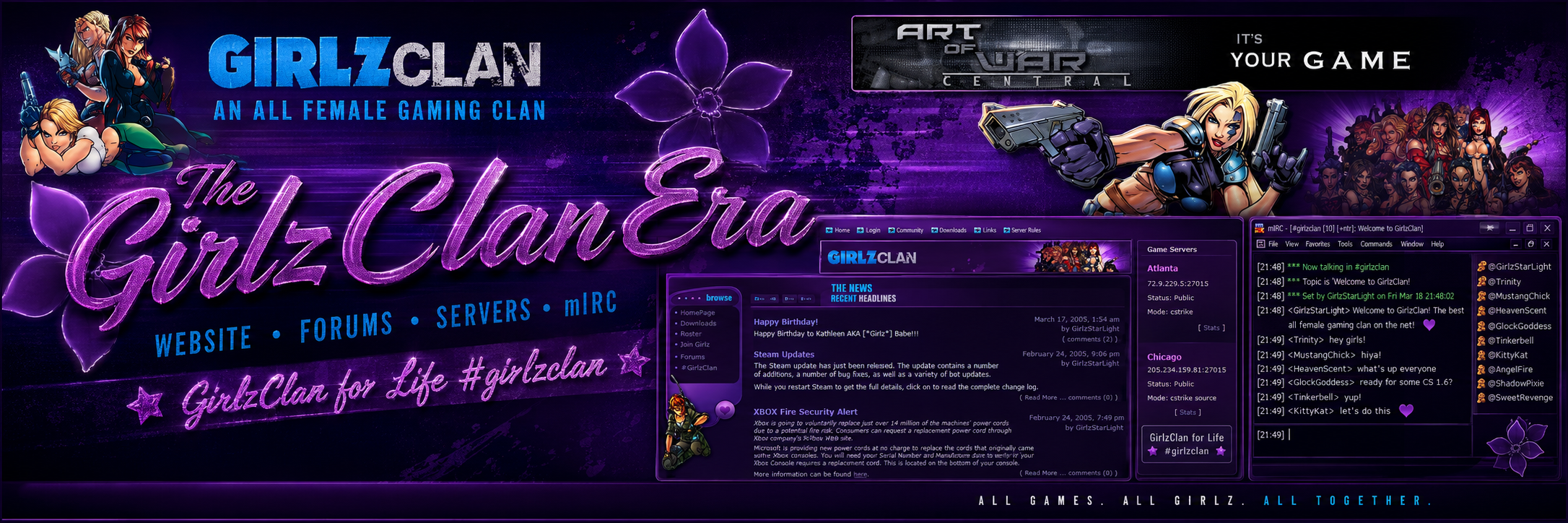
The website, forums, servers, and mIRC channel that turned GirlzClan into an online home people returned to night after night.
GirlzClan had begun as a way for women to find one another.
But once they did, they needed somewhere to stay.
The website I created had started as a practical place to keep our roster, post clan news, and organize matches. Over time, it became something much bigger.
It became our home.
The GirlzClan website grew far beyond the simple roster and news page I had first created.
It eventually held member profiles, photographs, forums, match results, private messages, downloads, recruitment information, server details, and separate areas for the games we played.

Eventually, more than 2,000 people registered on the website.
They weren’t all official GirlzClan members. Some were friends, regular players, members of other clans, or people who simply enjoyed spending time in the community.
They didn’t visit once and forget about us.
They came back again and again.
The forums were where match announcements appeared beside birthday wishes, graduation celebrations, holiday messages, and pictures of new babies. People came looking for someone to play with and stayed to talk about everything happening outside the games.
At its peak, the GirlzClan forums recorded 152 users online at once. On the community’s busiest recorded day, 72 registered members visited the forums.
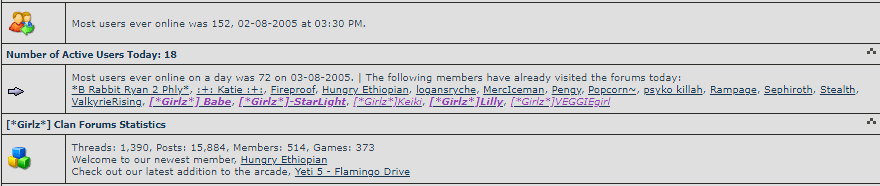
That number still amazes me.
GirlzClan had started with a handful of women hoping to find one another in Half-Life. Now, more than a hundred people could be gathered inside our online home at once.
Some of my favorite archived pages come from the recruitment forum.
Women posted introductions, asked about tryouts, and searched for other female gamers. Some arrived with years of experience. Others were nervous about whether they were good enough.
One post was simply titled:
“I’m not very good.”
I love that she felt comfortable enough to ask anyway.
We wanted skilled players, but skill was never the only thing that mattered. One of our old recruitment messages explained what we were really looking for:
“You must also possess a friendly outgoing attitude. Personality is of the most importance.”
The grammar may not have been perfect, but the meaning was.
A talented player could help us win a match.
A good person helped make GirlzClan somewhere people wanted to return to.
The website also gave people ways to carry a little piece of GirlzClan into their own online spaces. We offered custom sprays, player skins, wallpapers, and even GirlzClan-themed Steam skins.
The [*Girlz*] identity no longer appeared only when one of us entered a server. It showed up on computer desktops, inside games, and in the graphics people used to make their own little corner of the internet feel more like home.

Of course, a gaming community needed places to play too.
At different times, the GirlzClan world included our public server, Nameless’ Boot Camp, the Goddess Arena, and later a dedicated GunGame server.
Nameless was one of the Girlz, so her server was part of the community too. GirlzClan didn’t grow because everything belonged to one person. It grew because members contributed their time, resources, knowledge, and spaces to keep it going.
Art of War Central helped sponsor and host servers for us, including the Goddess Arena in San Jose, California.
That West Coast server was important because some of the Girlz struggled with high ping when they tried to play on servers located across the country. The Goddess Arena gave them a closer option and a better chance to enjoy the game instead of spending the entire night fighting lag.
The announcement to our West Coast players said:
“This one is for you!”
It may sound like a small technical detail now, but back then, your connection could decide whether a game was fun—or even playable.
The servers became more than equipment we rented or maintained.
They were where people gathered after work.
Where new players introduced themselves.
Where friends from other clans stopped by.
Where someone could log in on an ordinary night and usually find a familiar name waiting.
They also allowed us to host Counter-Strike Ladies Night every Tuesday.
The announcement began:
“Hello fellow female fraggers.”
Women from every time zone were invited to join us. Some were already part of GirlzClan. Others were meeting the Girlz for the first time.
For a few hours each week, a woman could enter the server knowing she wouldn’t be the only woman there.
In the beginning, I’d entered public servers wearing the [*Girlz*] tag and hoped other women would notice me.
Now, we had a place where they knew exactly where to find us.
Before Discord and social media, we also had our own mIRC channel:
#GIRLZCLAN
The servers were where we played, but mIRC was often where the night began.
Someone would join the channel to see who was awake, ask which server everyone was using, organize a practice, share match details, or simply talk while waiting for something to happen.
An archived report from only ten days in December 2002 recorded 321 different visitors to the channel.
Some came looking for server information.
Others seemed perfectly happy to sit there for hours talking about school, relationships, computer problems, or whatever strange subject had taken over the room that night.
We even had a trivia bot.
It kept scores, rankings, winning streaks, and typing speeds while everyone raced to answer questions first.
Apparently, I took that seriously too.
One surviving leaderboard placed Girlz|StarLight in fifth place, with 100 points and an eleven-answer winning streak.
Some nights, mIRC was about matches and strategy.
Other nights, it was a room full of familiar names arguing over trivia answers and saying things none of us expected would still be preserved in an archive more than twenty years later.
The early internet was a wild place.
But beneath the jokes, matches, and endless conversations, something deeper had formed.
The Girlz supported one another through real life.
Members talked on the phone and helped each other through personal problems. One Girl mailed microphones, sound cards, and other computer equipment to members who needed them.
Someone even sent a CD containing the latest Half-Life and Counter-Strike updates to a Girl who was still using a 28k connection.
Poor girl.
Trying to download those updates herself might’ve taken the rest of her natural life.
Those gestures said more about GirlzClan than any roster or website statistic ever could.
We noticed when someone needed help.
We celebrated when something good happened.
We worried when a familiar name suddenly stopped appearing.
In those days, someone could be part of your life almost every night and then simply disappear. There weren’t always social media accounts or other ways to find them. Sometimes all you had left was a gamer tag and the hope that she was doing all right.
That made the connections we kept even more precious.
GirlzClan had begun as a way for women to find one another.
Somewhere along the way, we’d created a place people didn’t want to leave.
The website gave us a home.
The servers gave us somewhere to gather.
The forums and mIRC gave us room to become part of one another’s lives.
But we weren’t content to remain names behind screens forever.
We wanted to compete.
We wanted to stand together beneath the [*Girlz*] tag and show the gaming world what we could do.
Soon, the friendships we’d built online would carry us into organized leagues, tournaments, and rooms lined with glowing monitors.
The community was ready.
And so were the Girlz.