
Chapter 2
The Founding of GirlzClan
Sierra created the first spark in 1999. When the Girlz nearly disappeared, StarLight rebuilt the idea into an international gaming community.

GirlzClan’s earliest roots began in Austin, Texas, in July 1999.
A player named Sierra wanted to prove to her boyfriend that other women really did play Half-Life, so she began wearing the tag:
[Girlz]
For several months, it remained more of an idea than an organized clan. A few women eventually began playing beneath the tag, including SexyGirl—whose name was Teresa—PsychoChick, Crazy*Girl!, Buffy, and me.
I first heard about the Girlz while watching my husband at the time play Half-Life. He belonged to his own clan, ~AAA~, and jokingly suggested that I should come play with them.
It was such a casual comment.
“Hey, you should come play this with them.”
Neither of us could’ve known where it would lead.
I began playing Half-Life in March 2000. Within my first week, I entered the servers as:
[Girlz]StarLight
A biography I wrote for the GirlzClan website in 2002 described what happened next in the wonderfully casual voice of my 23-year-old self:
“I started playing Half-Life in March of 2000. I joined this clan within my first week of playing, and yep yep 2 weeks later I was leading it. How funny is that!”
I was still learning the game when Sierra began preparing to move. She no longer had the time to manage the clan—or even much time to play. Without someone holding everything together, the group became disorganized. Members stopped showing up, interest faded, and the Girlz were slowly disappearing.
Before long, I was the last active member left.
I could have removed the tag and moved on.
Instead, I refused to let the idea die.
Being a woman in a hobby dominated almost entirely by men wasn’t always easy. There were plenty of good men who treated us as friends, teammates, and competitors.
Then there were the horrible boys.
I call them boys because real men didn’t speak to women that way.
Some players would insult us, sexualize us, question whether we belonged, or deliberately try to make the game so unpleasant that we’d leave. First-person shooters could be especially rough. Sometimes simply being recognized as a woman made you a target.
One night, another female player was being harassed in a server.
I wish I could remember her gamer tag. I wish I could remember exactly what was said or what I said when I stood up for her.
The words have faded.
The feeling hasn’t.
I remember seeing another woman being treated badly.
And I remember refusing to let her face it alone.
Eventually, the guy disconnected.
Maybe he got tired of arguing.
Maybe he rage-quit.
Or maybe his mom picked up the house phone to make a call and knocked him off the internet.
After he disappeared, the woman and I joked that girls should have their own clan so we’d always have civilized people to play with.
I never saw her again.
I don’t know her real name, where she lived, or whether she continued gaming. She may not remember me or that conversation at all.
But our brief encounter stayed with me.
It reminded me that women were already playing these games—we were simply scattered across different servers with no reliable way to find one another. We needed teammates who understood what it felt like to be outnumbered, underestimated, or targeted simply because we were women.
The Girlz name already existed.
I decided to give it a fresh start.
I changed my gamer tag from:
[Girlz]StarLight
to:
[*Girlz*]-StarLight
It may look like a small difference now—two stars, a hyphen, and a slightly different version of my name—but it represented the beginning of the GirlzClan I wanted to build.
I took over the leadership responsibilities and created a website—a place where the Girlz could have a roster, organize matches, share news, and exist together beyond a single game server.
Most importantly, it gave us a place to call home.
The new [*Girlz*] tag wasn’t subtle, and that was intentional. I wanted women to notice it when I entered a server. I wanted them to ask what it meant and realize there were other women looking for people like them.
Still, the first few months were difficult.
For more than three months, I struggled to find new members. I wore the tag into servers, talked about the clan wherever I could, and tried to make sure people knew that an all-female Half-Life clan existed.
There were moments when I worried GirlzClan might disappear before it ever had the chance to become real.
Then the word began to spread.
Women noticed us in servers. They found the website. They contacted us through email and ICQ. Slowly at first—and then much faster—the roster began to grow.
LivingDeadGirl, better known to us as LDG, became one of the women who stood closest beside me.
She became my co-leader.
LDG was deeply dedicated to GirlzClan. She helped welcome members, organize the clan, answer questions, and carry the responsibility of keeping a growing community together.
She didn’t simply wear the tag.
She believed in what it represented.
Her presence meant I didn’t have to build everything alone.
By March 2002, GirlzClan had grown to 25 active members, with many other Girlz having already passed through the clan by then. Within our first three years, more than 60 women had worn the tag.
Some stayed for years.
Others played with us for a shorter time before family, work, changing interests, or new games carried them somewhere else.
The active roster captured only one moment. It could never show every woman who had found us, played beside us, or left part of herself behind in the clan.
Our members came from across the United States, Canada, Europe, and Australia. GirlzClan grew beyond Half-Life Deathmatch and expanded into games such as Counter-Strike, Quake III, and Unreal Tournament 2003.
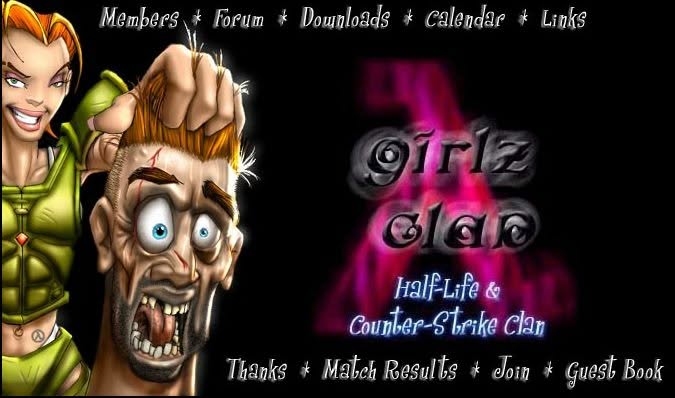
What had nearly disappeared in the spring of 2000 had become an international community.
While all of this was happening, I was raising two little girls, working part-time, maintaining a relationship, and balancing everything waiting for me away from the computer.
In my 2002 biography, I wrote:
“I juggle my playing time between my two small children, my part-time job and my boyfriend…”
That one sentence held an entire life.
Another part of the biography captured the fiery confidence and unapologetic attitude of the young woman I was then:
“I am sugar and spice and everything nice. I am a mother, daughter, sister, cousin and lover. I am a Goddess in my own right. I am woman, watch me kick ass.”
Reading those words now makes me laugh. The early internet was a wild place, and apparently my 23-year-old self had absolutely no intention of being subtle.
I was still figuring out who I was, but I was completely unwilling to let anyone else decide what I was allowed to become.
At the time, I wasn’t trying to make gaming history.
I was trying to keep a good idea from disappearing.
I wanted women to have teammates, friendships, and a place where they could play without constantly having to prove that they belonged.
Sierra had created the first spark.
When that spark was close to fading, I refused to let it go out.
I changed [Girlz]StarLight into [*Girlz*]-StarLight, created a home for the clan, and spent months making sure women knew how to find us. With LDG beside me, I built the community that GirlzClan became.
None of us could’ve known that the women behind those gamer tags would one day become part of each other’s histories—or that a clan created to help women find one another would reach far beyond the games we played.
At the time, we thought we were building a place to belong.
Looking back now, I realize we were building memories that would outlast the servers themselves.